Informed Risk Management
Understand exactly which trees pose a structural hazard and what corrective actions are needed.
Comprehensive, legally defensible tree assessments and reports prepared by AQF Level 5 consulting arborists.
Serving Wagaman, Moil, Alawa, Wanguri, and the greater Darwin region
Our arborist report Wagaman service delivers detailed, professional documentation for planning, risk management, insurance claims, and tree health diagnostics.
While City of Darwin by-laws do not mandate private removal permits, consulting arborist reports provide critical liability protection and risk documentation for properties with aging large trees over lateritic soils.
Understand exactly which trees pose a structural hazard and what corrective actions are needed.
Ensure your building plans meet AS4970 standards to protect retained trees during construction.
Receive formal written evidence for insurance claims, boundary disputes, or asset management.
Our AQF Level 5 arborist inspects trunk integrity, canopy density, root flares, and site soil conditions.
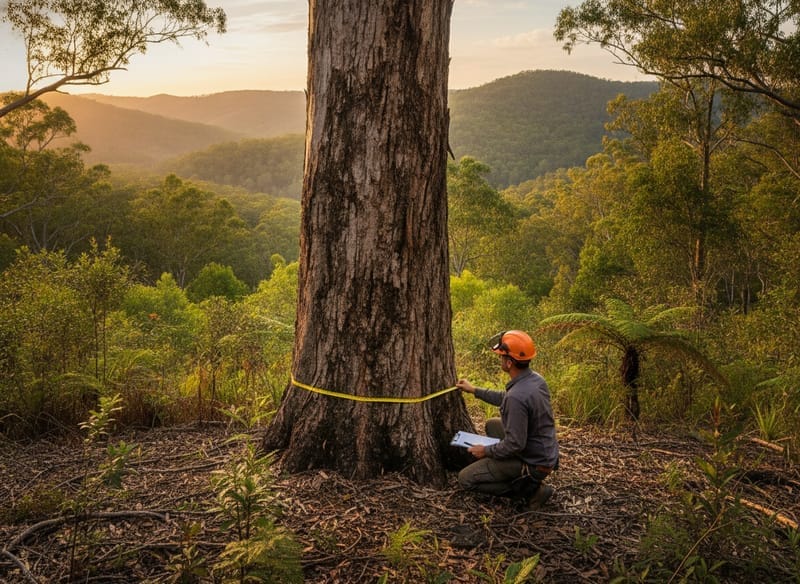
We take precise measurements, photo evidence, and calculate TPZ/SRZ or risk scores.
We draft a comprehensive written report detailing findings, risk ratings, and actionable recommendations.
You receive a digital report ready for submission to certifiers, insurers, or legal representatives.
Whether you are a local homeowner managing storm-damaged canopy, a property manager overseeing strata maintenance, or a builder planning a new residential project, securing a professional Arborist Report Wagaman is the crucial first step. Darwin's monsoon tropics demand a specialised approach to tree management. With torrential wet seasons, prolonged dry spells, and the ever-present threat of severe tropical cyclones, understanding the structural integrity of your trees is a matter of safety and duty of care.
While the City of Darwin does not require permits for routine tree removals on private, standard suburban blocks, formal documentation remains essential for other reasons. An Arborist Report Wagaman provides the authoritative, independent analysis needed for development applications, insurance claims, and pre-purchase property inspections.
Our team of consulting arborists delivers rigorous, AQF Level 5 assessments tailored to the unique conditions of the Top End. We help you navigate local soil constraints, post-cyclone recovery, and structural root issues, ensuring your property remains safe and compliant year-round.
A common mistake property owners make is relying on unqualified advice when assessing the health and safety of large mature trees. In Wagaman, guessing the structural integrity of a tree can have devastating consequences. During Cyclone Marcus and the unprecedented Category 3 Cyclone Fina, thousands of trees failed across Darwin. Many of these failures were completely predictable to a trained eye, caused by balled root systems from overwatering and shallow root plates resting on Darwin's lateritic hardpan.
When you hire a tree lopper instead of a qualified consulting arborist, you risk receiving inaccurate advice. They may recommend unnecessary, damaging topping—which creates weak epicormic regrowth and accelerates decay—or they may miss critical signs of root plate lifting. Furthermore, if you are submitting a development application, builders and certifiers will outright reject reports that do not meet Australian Standards.
Our solution is to provide comprehensive, AS4970 and AS4373-compliant reports drafted by AQF Level 5 consulting arborists. We conduct thorough Visual Tree Assessments (VTA) that hold up to the scrutiny of insurers, engineers, and property managers. By properly identifying high-risk species like poorly planted African Mahogany and assessing their root structures against local soil profiles, we give you the factual basis needed to make safe, legally sound decisions for your Wagaman property.
Our consulting team utilises industry-leading methodologies to deliver accurate, highly detailed reports. Every assessment is specifically calibrated to the Top End's climate, soil profiles, and local species.
We conduct detailed Visual Tree Assessments (VTA) focusing on structural defects, disease, and root stability. This is highly recommended for assessing large species like Darwin Woollybutt or African Mahogany, particularly after monsoon events. We document target zones, likelihood of failure, and provide actionable recommendations to mitigate risk.
Required for construction projects to ensure retained vegetation survives earthworks. We calculate Tree Protection Zones (TPZ) and Structural Root Zones (SRZ) based on trunk diameter (DBH), specifying protective fencing, root mapping, and mulch requirements in strict accordance with AS4970 Protection of Trees on Development Sites.
Following severe weather like Cyclone Fina, insurers often require expert documentation to process property damage claims. We provide independent, causation-focused reports detailing why a tree failed—whether due to lateritic soil hardpans, pre-existing decay, or unprecedented wind loads.
Before buying a property in Wagaman, our AQF Level 5 arborists evaluate the existing canopy. We identify protected weeds, assess the Safe Useful Life Expectancy (SULE) of mature trees, and outline your future maintenance liabilities so you can purchase with total confidence.
Getting a professional tree report shouldn't be complicated. We have refined our process to ensure fast, accurate, and fully compliant documentation for Wagaman residents and builders. First, we start with an initial consultation to determine the exact nature of your requirement. We need to know if you are managing a dispute, filing an insurance claim after a wet season storm, or preparing a site for construction. Next, our AQF Level 5 consulting arborist will visit your Wagaman property to conduct on-site data collection. We measure the Diameter at Breast Height (DBH) of all relevant trees, photograph structural defects, map out the canopy spread, and examine the soil conditions. For development sites, this includes marking out necessary Tree Protection Zones. Once the field data is collected, we move to the analysis and drafting phase. We cross-reference our findings with AS4373 pruning standards or AS4970 development guidelines, factoring in the specific resilience of local species like Sea Almond or Banyan trees. Finally, we deliver a comprehensive, formally signed PDF report. This document includes all raw data, high-resolution site photos, hazard ratings, and clear, actionable recommendations that you can forward to your certifier, insurer, or property manager.
Every Arborist Report Wagaman we produce is written and signed off by an AQF Level 5 Diploma-qualified consulting arborist. This is the exact credential required by courts, insurers, and certifiers across the Northern Territory.
Our recommendations are strictly governed by AS4373 Pruning of Amenity Trees and AS4970 Protection of Trees on Development Sites. We absolutely refuse to recommend or endorse "topping" or "lopping" practices. To protect our clients and our business, we are fully covered by public liability and professional indemnity insurance, ensuring our expert advice is backed by comprehensive financial protection.
Understanding tree management in Wagaman requires deep local knowledge of both the regulatory environment and the natural landscape. Unlike southern states, the City of Darwin does not enforce a private land tree permit system or a significant tree register for standard residential blocks. However, By-laws 102 and 103 protect public vegetation and compel owners to maintain clear verges. The real challenge in Wagaman lies in the ground. Darwin's terrain features a gravelly sandy surface over a lateritic hardpan, which severely restricts rooting depth. When combined with our monsoonal wet season, this shallow rooting leads to a high rate of windthrow. The legacy of Cyclone Marcus and the recent Cyclone Fina proved that certain species, particularly older African Mahoganies planted for quick shade, are highly vulnerable. Conversely, native resilient species like Northern Milkwood and local melaleucas tend to perform much better. Our reports specifically factor in these local soil limitations and species profiles to give you an accurate assessment of hazard and longevity.
Once your report is delivered, the subsequent steps depend entirely on our findings. If the report identifies a high-risk hazard tree, our AQF Level 3 climbing arborists can be deployed to execute a safe, targeted removal or AS4373-compliant crown reduction. For Wagaman development sites, you must install the mandated protective fencing and root protection measures exactly as outlined in our AS4970 Tree Protection Plan before any heavy machinery arrives on site. We highly recommend keeping your digital report on file, and scheduling a follow-up Visual Tree Assessment every two to three years, or following any severe tropical cyclone or monsoon trough.
Arborist report pricing in Wagaman is based on the report type, number of trees inspected, and diagnostic complexity.
We provide clear, fixed-fee quotes based on the scope and purpose of your required arborist report.
Authoring certified arborist reports across Wagaman and all surrounding northern Darwin suburbs.
Contact our AQF Level 5 consulting team to discuss your assessment requirements.
Request a Report Quote