Restored Property Safety
Remove dangerous hung branches and unstable trees before the next monsoonal rain system arrives.
Post-cyclone cleanup, hazard clearance, and multi-tree restoration across Ludmilla.
Covering storm cleanup in Ludmilla, Parap, Fannie Bay, Nightcliff, and all Darwin suburbs.
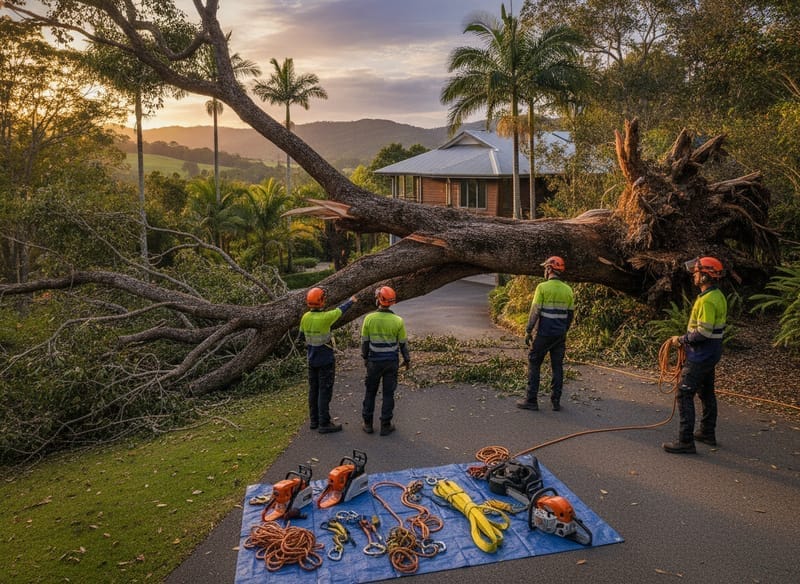
Our storm damage tree removal Ludmilla service focuses on clearing yards, removing compromised limbs, and restoring safety after intense weather events. We systematically process tangled branch piles, dismantle hung-up limbs, and safely fell trees damaged beyond recovery.
Severe tropical weather events like Cyclone Fina leave extensive damage across Ludmilla's mature tree canopy. Trees that remain standing often have internal structural fractures or severed anchor roots in saturated laterite soil, presenting ongoing hazards long after the storm passes.
Remove dangerous hung branches and unstable trees before the next monsoonal rain system arrives.
Transform storm-ravaged blocks into tidy, safe outdoor living spaces with all green waste cleared.
Receive clear, accurate documentation that meets insurer requirements for storm damage tree claims.
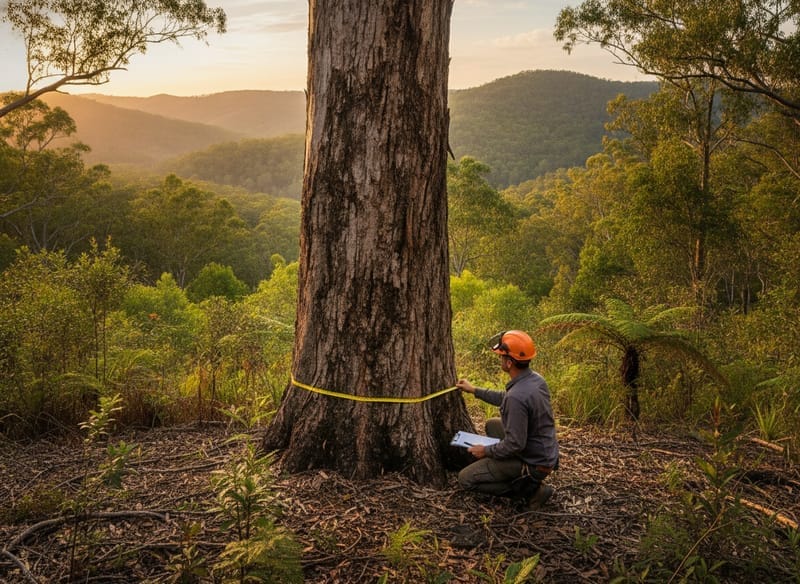
We inspect your Ludmilla property to catalogue all storm-affected trees, hung limbs, and structural impacts.
We formulate a safe clearance strategy, targeting high-risk suspended branches and access obstructions first.
Our qualified crew cuts, rigs, and chips all green waste, using winches to safely pull down hung limbs.
We rake the site clear of storm debris and issue your insurance-compliant invoice and documentation.
When severe tropical weather strikes the Top End, the aftermath can be devastating for mature suburban canopies. If you need Storm Damage Tree Removal Ludmilla property owners can rely on our local, qualified arborists to secure hazards and clear debris safely. We understand that the monsoon wet season brings saturated soils and high winds that push established trees past their breaking point, threatening homes, fences, and powerlines. The destruction left by recent events like Cyclone Fina has proven just how vulnerable residential blocks are to catastrophic windthrow. With winds ripping through Ludmilla, even seemingly healthy vegetation can suffer snapped limbs, twisted canopies, or complete uprooting. Our team provides an immediate, systematic response to secure your property. Whether you are dealing with a massive branch suspended dangerously over your driveway or a fully uprooted trunk resting on your roof, rapid professional intervention is critical. We prioritise making your site safe, carefully dismantling compromised timber, and providing the documentation you need for a straightforward insurance claim.
Attempting to manage storm-damaged trees without professional arboricultural training is incredibly dangerous. Following intense weather systems, fallen and partially fallen trees are loaded with unpredictable tension and compression forces. A single misplaced chainsaw cut by a well-meaning homeowner can cause massive logs to roll, snap back, or drop suddenly, leading to severe injury or fatal accidents. Furthermore, DIY cleanups often involve harmful practices like "lopping" or "topping" broken branches. Under AS4373 (Pruning of Amenity Trees), these indiscriminate cuts are heavily discouraged. Lopping leaves large, raw stubs that encourage rapid fungal decay and trigger the growth of weak epicormic shoots. In the next wet season, these weakly attached shoots become the first things to snap off and become flying hazards. Our qualified climbers and ground crews solve these problems by employing advanced rigging, tension-release cutting techniques, and AS4373-compliant restorative pruning. If a tree's structural integrity is compromised beyond repair, we move to a complete removal. We understand Darwin's lateritic red soil and the shallow hardpan that restricts rooting depth, which is why we can accurately identify trees that have suffered partial root plate failure. We eliminate the guesswork, ensuring that hanging branches are safely lowered and unstable trees are fully removed before the next squall hits.
When a severe storm or cyclone impacts the Top End, safe tree removal requires specialised equipment and a disciplined methodology. Here is how our arborists execute emergency clearances in Ludmilla.
Upon arrival at your Ludmilla property, we systematically tag trees by priority. Immediate hazards over structures or accessways are addressed first, followed by hung-up limbs (widow-makers) and secondary cleanup of fallen timber. We also take comprehensive pre-work photographs for your insurance records.
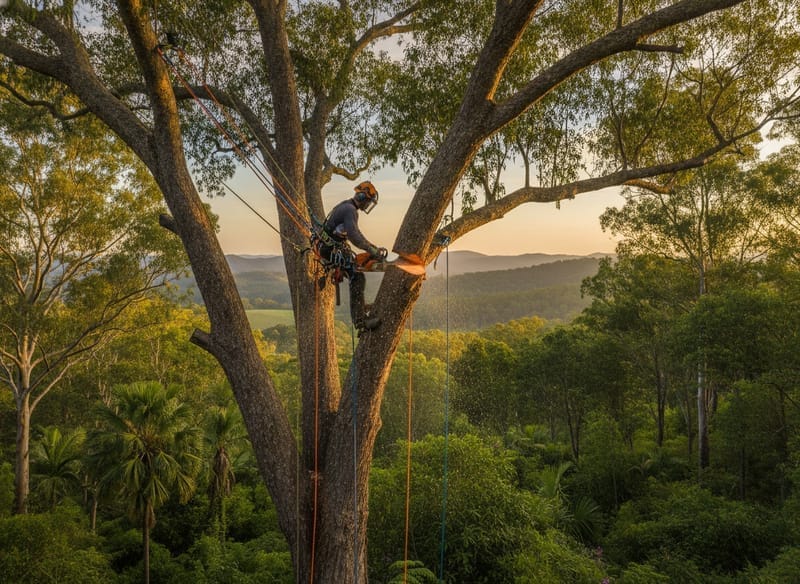
For fractured canopies suspended above outbuildings, our AQF Level 3 climbing arborists use double-rope techniques and top-handle climbing saws (like the MS201T). We install friction devices to safely lower heavy limbs to the ground in controlled sections, preventing any secondary impact damage to your property below.
Darwin's lateritic hardpan causes shallow root systems, leading to massive root-plate failures during cyclones. We use high-capacity ground saws (MS500i, 572XP) and specific relief cuts to release the enormous tension in the trunk. This prevents the heavy root ball from violently snapping back into the hole during cross-cutting.
When severe windthrow drops enormous trees directly onto houses, standard elevating work platforms (EWPs) often cannot reach the site. We coordinate crane-assisted removals, allowing our arborists to sling and lift multi-tonne sections of timber safely over rooflines and into our waiting trucks.
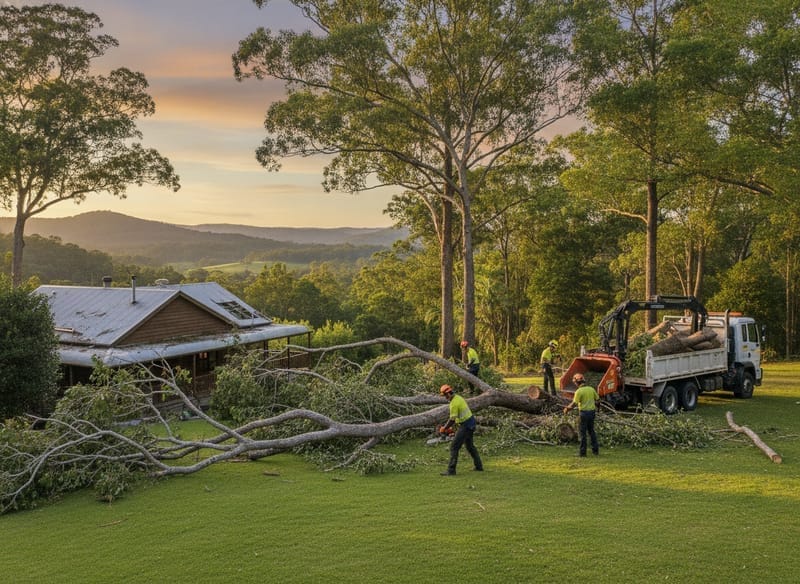
Once the hazards are dismantled, our ground crew processes the debris using 12-inch commercial wood chippers. The resulting mulch is either stockpiled for your garden's moisture retention or hauled away in our tipper trucks to the Hidden Valley green waste facility.
When you contact us for emergency storm response, our first priority is establishing a safe perimeter. We begin with a rapid on-site inspection, assessing the structural stability of the damaged trees and identifying live powerlines or immediate structural threats. We generate a detailed, line-by-line quote and capture photo evidence, which is essential for seamless processing with your insurance provider. Once approved, our ground crews and climbers secure the work zone. If the fallen tree extends onto public roads or verges, we implement necessary traffic management protocols in line with City of Darwin safety requirements. Our climbing arborists then ascend to remove hung-up limbs and reduce canopy weight, while ground personnel process the lowered branches. For uprooted trees, we carefully dismantle the trunk, neutralising the tension in the root plate. After the main timber is cleared and processed through our wood chippers, we can deploy our self-propelled stump grinders to chase out the remaining stump 150–300mm below grade. Finally, we rake the site clean and haul all unwanted green waste away, leaving your Ludmilla property safe, accessible, and ready for repairs.
Safety and compliance are non-negotiable in the highly hazardous environment of post-storm cleanups. Our team operates with fully insured public liability cover and comprehensive WorkCover for all employees. Every climber holds an AQF Level 3 Certificate in Arboriculture, ensuring they understand the complex mechanics of damaged timber. When attempting to save storm-damaged trees, all restorative pruning is executed strictly in accordance with AS4373 (Pruning of Amenity Trees) to promote healthy recovery and prevent future decay. We also carry essential tickets for Elevating Work Platforms (EWP), Working at Heights, and First Aid, ensuring our emergency response is as safe as it is highly effective.
Darwin's extreme monsoonal climate and unique soil profile heavily dictate how trees fail in Ludmilla. As we saw during Cyclones Fina and Marcus, the combination of our lateritic red soil's shallow hardpan and oversaturated wet-season ground leads to catastrophic windthrow. Species planted for quick shade, particularly African Mahogany, repeatedly suffer total root-plate failure or massive branch drop. The regulatory landscape here is a significant advantage in an emergency. The City of Darwin has no private tree permit system and no protected tree register for residential blocks. By-laws 102 and 103 only govern public land and your obligation to keep the verge clear. Furthermore, the Northern Territory Planning Scheme's clearing overlays generally do not apply to standard urban residential zones like Ludmilla. This means our arborists can respond to your storm damage, without waiting for council development applications or red tape. We focus on efficiently removing hazardous exotics and ruined vegetation, while advising on how to safely retain resilient native species like Northern Milkwood or Sea Almond wherever possible.
After we complete your Storm Damage Tree Removal Ludmilla, it is vital to monitor the vegetation that survived. The extreme winds of a cyclone can cause hidden micro-fractures in the remaining canopies that may not fail until weeks later. Keep an eye out for sudden epicormic growth, newly dead branches, or soil heaving around the base of the trunk.
Avoid overwatering your remaining trees; as local history has shown, waterlogged soils lead to balled root systems that fail easily in high winds. If you notice a retained tree developing a new lean, or if you want a proactive health assessment before the next wet season arrives, call our team for an inspection.
Storm damage cleanup pricing in Ludmilla depends on the volume of debris, the severity of tree damage, and the machinery required.
We provide detailed, written fixed quotes suitable for home insurance claims.
We provide storm damage tree removal across Ludmilla and surrounding Darwin suburbs.
Clear storm debris and make your property safe with our qualified Darwin team.
Get a Free Quote